Before You Buy Another “Collagen” Product, Look at What Shiseido Is Studying.
“Contains collagen” and “supports your skin’s collagen” are not the same claim. Shiseido’s research offers a useful way to understand what actually matters.
Collagen has become one of beauty’s favorite words.
It’s in creams, masks, serums, powders and drinks, often accompanied by the same promise: firmer, younger-looking skin.
But there’s an important distinction hiding behind all that marketing.
Putting collagen in a product is not the same thing as helping your skin maintain its own collagen.
And if you look at what Shiseido has actually been researching, the collagen conversation becomes much more interesting.
Collagen Is a System, Not Just an Ingredient
Much of the collagen responsible for skin's structure sits in the dermis, beneath the epidermis.

Shiseido's research has increasingly focused not simply on whether collagen exists, but on what happens to the system surrounding it.

In 2022, its researchers reported that an age-related imbalance in certain immune cells called macrophages could affect collagen metabolism—suppressing production while encouraging fragmentation. More recently, Shiseido reported that M2 macrophages may also play a role in creating thicker, denser, more mature collagen fibers.
Then came another interesting finding.
In July 2026, Shiseido reported laboratory research showing that cilantro fruit extract helped reduce senescent—or aged, poorly functioning—cells while increasing normal cells, which was associated with increased collagen production. It's early-stage research, not proof that cilantro skincare will rebuild your face, but the direction is telling: researchers are looking at the environment in which collagen is made, not simply adding collagen to a formula.
So What Should You Actually Look For?
This is where the beauty aisle gets easier to navigate.
When a product says “with collagen,” ask what the collagen is supposed to be doing.
Topically applied collagen can be useful as a moisturizing or film-forming ingredient, helping skin feel smoother and more hydrated. But don't automatically translate “contains collagen” into “replaces lost dermal collagen.”
Those are very different things.
If your goal is preserving the collagen structure associated with firmness and wrinkles, the more useful question is:
What does the formula do to support or protect my skin's existing collagen system?
One familiar ingredient becomes particularly relevant here: retinol.
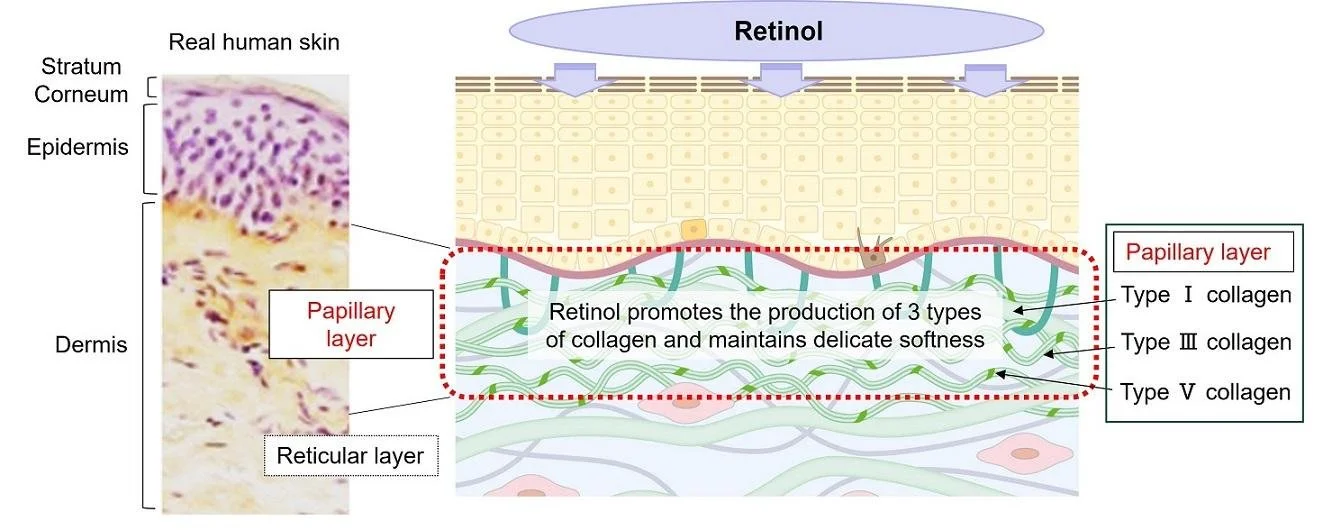
In 2025, Shiseido reported research involving the papillary dermis—the upper portion of the dermis—where types I, III and V collagen form fine fibers. Its researchers found that retinol promoted production of all three collagen types in their experimental work and proposed that maintaining this softer collagen structure may help the skin absorb mechanical stress associated with wrinkle formation.
UV protection matters for an even less glamorous reason: UV exposure contributes to collagen breakdown. Shiseido's earlier research found photoaging was associated with reduced collagen production and increased fragmentation.
In other words, sometimes the smartest “collagen product” in your routine doesn't say COLLAGEN on the bottle at all.
The Clèco Check
Before buying something because collagen is written across the front, turn it around and ask:
Does it contain collagen mainly to hydrate and condition the surface?
Does it contain an evidence-backed active intended to influence collagen-related processes in skin?
Does it help protect against something known to damage collagen, particularly UV exposure?
Or is collagen simply the word doing the most work?
That's the distinction worth saving.
Because the future of collagen skincare probably isn't about finding increasingly luxurious ways to put collagen on your face.
If Shiseido's research direction is any indication, the much bigger question is learning how to protect and influence the complicated biological machinery already underneath it.
