Being Clean Is No Longer Enough: The AI Visibility Gap in Modern Beauty
Indeed, the clean beauty movement has won the argument. Today's customers are quite different from the ones we encountered in the past; they expect high-quality, transparent, and sustainable products, with immediate, empathetic service across digital channels.
This has led to more products with B Corp accreditation, no endocrine disruptors, non-toxic chemicals, and environmentally friendly packaging. However, ethically clean and sustainable brands are quietly disappearing from the most important conversation happening in their industry right now. None of it matters as much as it should — if the audits are accurate, the formulation functions, and the credentials are genuine.
"Clean" Has Become a Crowded Room
When can consumers truly trust that a non-toxic label signifies a product is safe? The stakes of mislabeling or overpromising are high, not just for consumer health, but for the reputation of your brand.
According to a 2024 survey, approximately 65% of adults report difficulty determining whether a brand is overstating its eco-friendly claims — a trust deficit that deepens as the category expands. (Free Yourself, Clean Skincare Brand Statistics, 2025)
Take a guided tour of any beauty retailer, and products are labeled as "clean," "conscious," "non-toxic," "free from endocrine disruptors," "sustainable," and "B Corp certified." The terminology that once signified a real commitment to human health has become wallpaper for an entire category.
Key Market Shift:
Over 45% of new skincare launches in 2024 incorporated "clean" claims — a 21% rise from 2022(360 Research Reports, 2024)
More than 67% of global consumers now prefer products labeled as clean, natural, or sustainable (360 Research Reports, 2024)
"Clean" no longer differentiates. It qualifies.
The clean beauty and non-toxic brands are exceptional — but they created the necessity for everyone to use the buzzwords they invented, including those with far laxer norms.
Beauty brands that educate calmly, explain their reasoning clearly, and respect users' intelligence are asking: if clean is the floor, what is the ceiling? The response is increasingly artificial intelligence (AI).
The Room No One Told You About
A sizable and growing percentage of consumer inquiries — where to find the best non-toxic moisturizer for sensitive skin, which sustainable brands are actually credible — are no longer being entered into Google. They are being asked directly of AI systems such as ChatGPT, Perplexity, Gemini, and Claude.
The scale of this shift:
As of mid-2025, ChatGPT alone processes approximately 2.5 billion prompts per day(Frase.io GEO Analysis, 2025)
49% of consumers used AI at some point in their shopping journey in 2025, with 39% citing product discovery as a primary use case (PartnerCentric, survey of 1,004 consumers, December 2025)
AI-referred sessions jumped 527% year-over-year in the first half of 2025 (Frase.io, 2025)
These platforms are now serving as the initial point of reference for the same type of values-driven, research-driven customer that clean and impact brands — including B Corp-certified companies, ESS-aligned organizations, and labels recognized by frameworks such as Mouvement Impact France — have spent years building trust with.
This is the distinction that changes everything. AI visibility operates as a black box that generates responses based on patterns learned from existing content — and not by reputation, community size, press mentions, or the integrity of a formula. These systems use large language models (LLMs) that interpret content contextually and prioritize structured, well-organized, cited, expert, and authoritative information, leaving many purpose-led brands effectively invisible.
What AI Actually Shows
When users turn to AI platforms for beauty recommendations, the outputs follow a consistent and revealing pattern.
Query:"What is the best non-toxic moisturizer for sensitive skin?"
AI responses typically include:
Dermatologist-backed or clinically positioned brands
Products with ingredient-specific, factual descriptions
Brands with consistent editorial coverage across multiple platforms
Content cited by ChatGPT due to its structured, verifiable formatting
Often missing:
Clean beauty brands with strong third-party certifications
B Corp-certified brands with high real-world authority
Impact brands whose credentials exist but are not structured for AI retrieval
Query:"Best sustainable luxury skincare brands"
AI responses typically include:
Brands with repeated third-party references across editorial and commerce platforms
Clearly defined, machine-readable positioning
Brands whose sustainability claims are numerically grounded and citable
Often missing:
ESS-compliant and Mouvement Impact France-recognized brands whose impact is real but digitally unstructured
Brands relying on visual storytelling, packaging narrative, or community trust rather than citable content
On the basis of their formulations and editorial clarity, brands such as Pai Skincare remain largely absent from AI recommendation layers despite existing market presence. In fashion, Chloé — the first luxury label to earn B Corp accreditation — appears inconsistently in AI results for sustainable luxury queries, despite credentials that should position it at the forefront of the discourse.
The gap between these brands' real-world authority and their AI visibility is not a reflection of their quality. It is a reflection of their discoverability.
What AI Systems Actually Prioritize
AI systems do not evaluate brands the way humans do. They evaluate content the way machines do.
AI consistently favors:
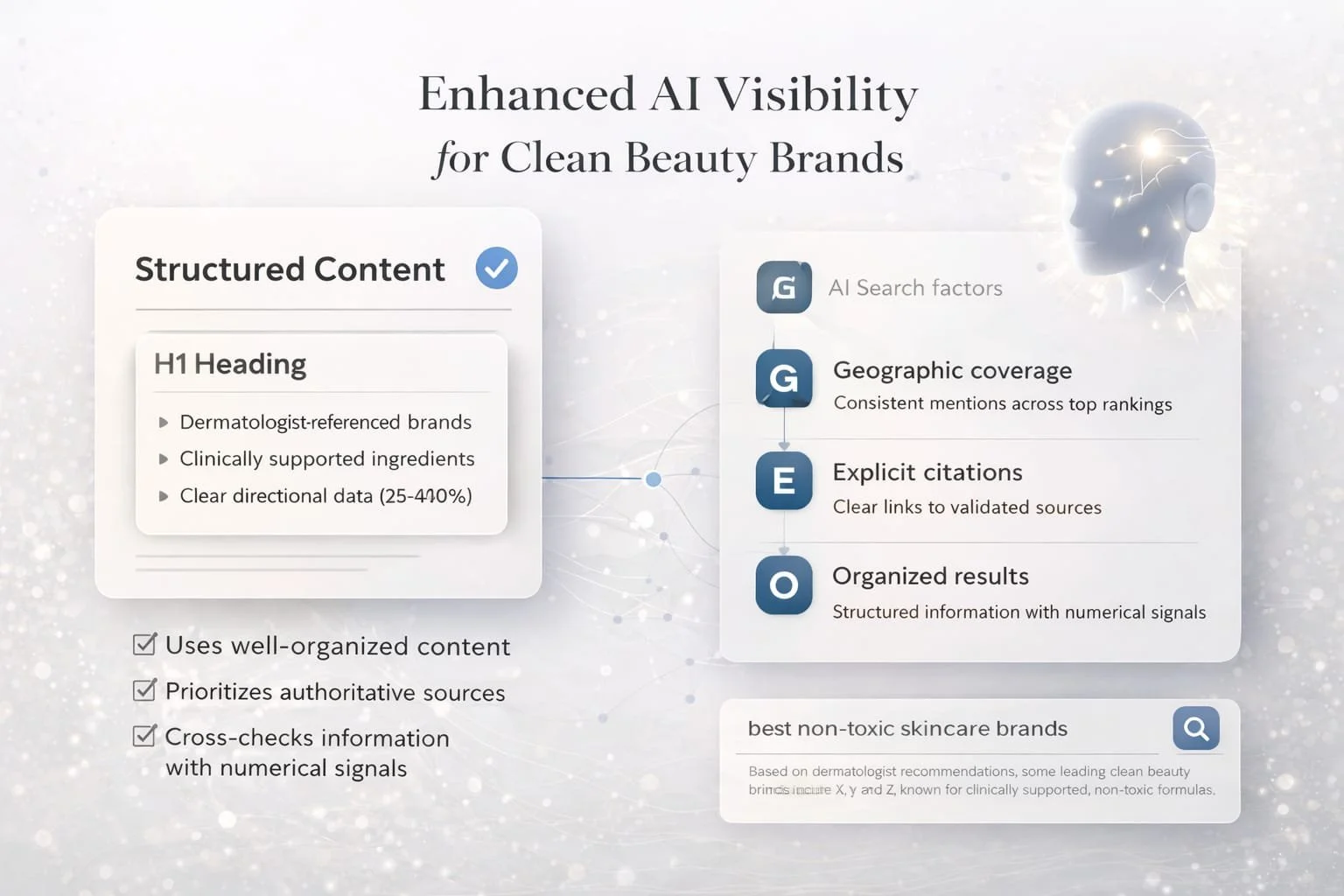
Structured formatting — headers (H2, H3), sections, clearly separated ideas
Numerical and factual claims — statistics, percentages, clinical references
Third-party validation — certifications, named sources, citable references
Consistency across platforms — the same positioning, repeated and reinforced across multiple domains
AI does not prioritize:
Brand reputation or heritage
Aesthetic positioning or packaging narrative
Community size or press mentions alone
Qualitative claims without supporting data
Research from Princeton University, Georgia Tech, and IIT Delhi — published at the ACM SIGKDD 2024 conference — confirmed that content enriched with statistics and verifiable citations achieved 30–40% higher visibility in AI-generated responses compared to unoptimized content. Internal tracking published by GenOptima found that content sections containing three or more data points per 300 words achieved a 2.1x higher citation frequency — a figure now recognized as a foundational GEO coefficient across ChatGPT, Perplexity, and Microsoft Copilot.
Brand Visibility Gap in AI — A Craft with a Methodology
The goal is not simply to understand whether you're mentioned — it is to understand how consistently, in what context, and against which competitors. This is where Generative Engine Optimization (GEO) emerges as a distinct discipline, and where a specialized GEO agency becomes the difference between authority that exists and authority that gets found.
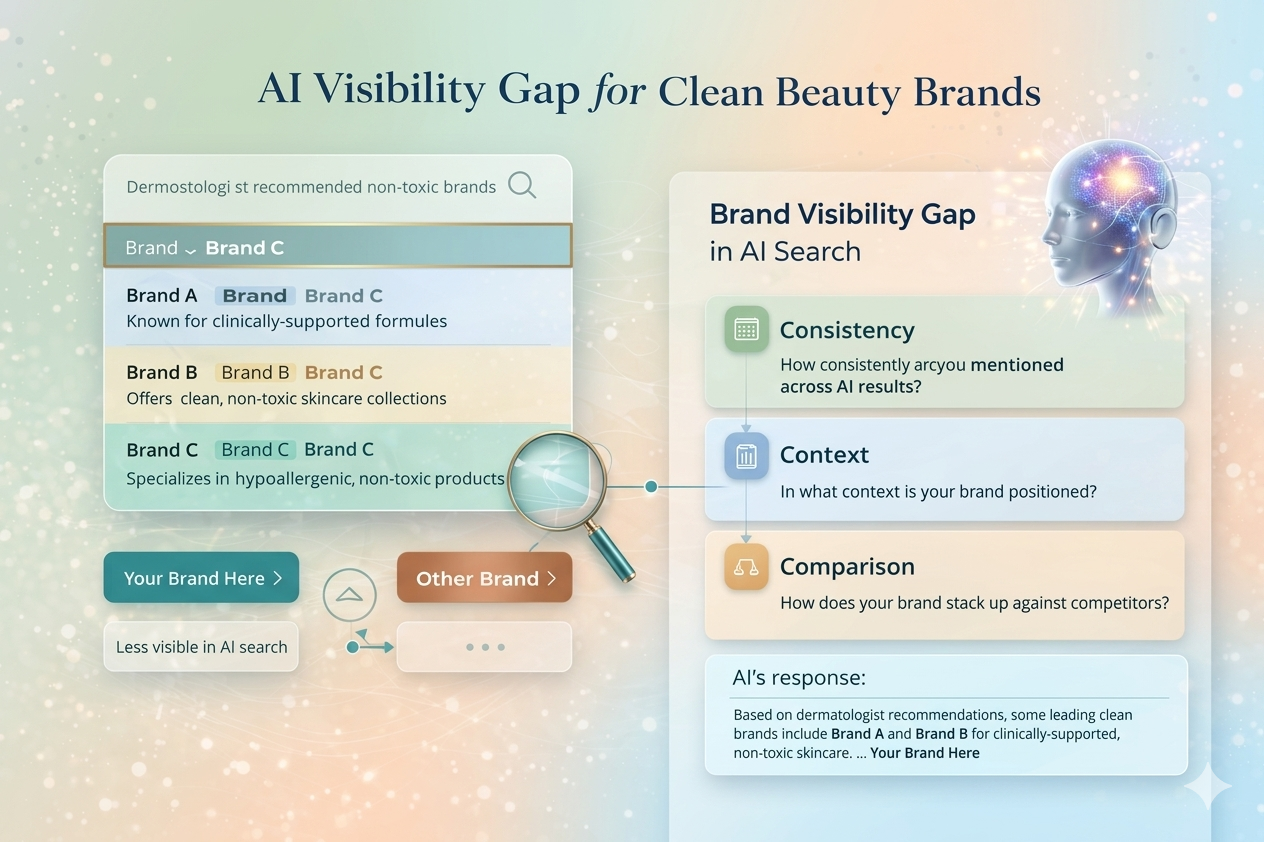
Unlike SEO, which focuses on discoverability through ranked links, GEO focuses on being cited inside AI-generated answers. It means ensuring your content is trustworthy, well-referenced, and structurally authoritative — optimized not for a search algorithm, but for the large language models (LLMs) that now mediate how millions of consumers discover what to trust and what to buy.
Observed pattern:
Only 30% of brands remain visible from one AI answer to the next
Just 20% stay present across five consecutive runs of the same query (AirOps, analysis of 45,000 AI citations, 2025)
Visibility gaps of50–80% between expected authority and actual AI citation frequency are not uncommon in GEO audits
Platforms such as Phloxe (phloxe.io) — a GEO agency working at the intersection of impact brands, structured content, and AI visibility — are at the forefront of mapping these gaps. Recognized within the French Tech Tremplin ecosystem and aligned with the values of Mouvement Impact France, Phloxe conducts GEO audits that analyze how often brands are cited by ChatGPT, Perplexity, and Google AI Overviews — and more importantly, why they are not. For B Corp-certified, ESS-recognized, and impact-driven beauty brands, the audit frequently reveals that the distance between where they are and where they should be cited is less a function of authority, and much more a function of structure.
This Is Not Theoretical
Across AI platforms, brands with structured, data-supported content are cited more frequently than those relying solely on visual storytelling or brand positioning. The Similarweb 2025 Generative AI Landscape Report found that referrals from AI chatbots to transactional sites convert at approximately 7% — significantly higher than most traditional traffic sources — because users arriving from an AI recommendation have already progressed through the awareness stages of the buying journey.
The window for early-mover advantage is narrowing. By Q1 2026, Google AI Overviews appear in an estimated 50% or more of all searches. Brands whose content is not structured for citation are falling further behind with every passing quarter.
What This Means for Clean Beauty
Clean beauty has established credibility. AI visibility will determine relevance.
Brands that will be surfaced:
Those who educate clearly and structure information
Those that reinforce claims consistently across platforms
Those whose authority is verifiable, not just visible
Brands at risk of invisibility:
Those relying solely on aesthetics, values, or packaging narrative
Those whose strongest content lives in visuals rather than structured text
Those whose credibility is real — but whose content architecture does not communicate it to LLMs
It is no longer sufficient to be clean. For impact brands, B Corp-certified labels, and ESS-aligned organizations, being visible to AI may be the most crucial next step — because the customers who care most about what you stand for are now asking AI where to find you.
Because in an AI-driven discovery landscape, if your brand cannot be interpreted, it cannot be recommended.
FAQ
What is GEO, and how is it different from SEO? Generative Engine Optimization (GEO) is the process of structuring your brand's content so that AI platforms — including Google AI Overviews, ChatGPT, and Perplexity — mention, cite, or recommend you when users search for solutions. The discipline was formalized in peer-reviewed research at the ACM SIGKDD 2024 conference by researchers at Princeton University, Georgia Tech, and IIT Delhi. Unlike SEO, which optimizes for ranked link positions, GEO optimizes for citation within AI-generated answers — where your content must be structured, authoritative, and consistently cross-referenced to earn inclusion. A GEO agency specializes in exactly this gap: translating real-world brand authority into AI-readable content that gets cited.
Why isn't my clean beauty or impact brand showing up in AI search tools? Many clean beauty, B Corp-certified, and ESS-aligned brands prioritize aesthetics, storytelling, and ethical positioning without considering whether their content is comprehensible to the large language models (LLMs) that interpret meaning and context for AI systems. The result is an AI visibility gap that has nothing to do with brand quality and everything to do with content architecture. As AI-referred sessions jumped 527% year-over-year in the first half of 2025, the cost of this gap compounds monthly.
What does it mean to be cited by ChatGPT or another AI platform? When a customer queries an AI system for non-toxic wellness products, sustainable skincare, or impact-driven brands, the platform uses citable references to support the response it generates. Being cited by ChatGPT, Perplexity, or Google AI Overviews means your brand's content serves as an indicator of reliability — helping users understand the source of the information and providing a pathway to explore further. Critically, AI-referred visitors convert at approximately 7% — significantly higher than most traditional traffic — because they arrive with strong, specific purchase intent. (Similarweb, 2025)
Does the "clean" label still build trust and differentiate brands in 2026? Not on its own. With over 67% of global consumers now preferring products labeled clean, natural, or sustainable, the label signals participation in a majority category — not differentiation within it. For impact brands, B Corp-certified companies, and organizations recognized by frameworks such as Mouvement Impact France or French Tech Tremplin, the credibility is real — but it must be structurally communicated in a way that AI systems can retrieve, interpret, and cite.
What is a GEO audit, and what does it reveal? A GEO audit is an organized analysis of how your brand appears across AI-powered platforms — including ChatGPT, Perplexity, and Google AI Overviews — measuring how consistently you are cited, in what context, and against which competitors. The GEO coefficient emerging from this analysis reflects the gap between a brand's real-world authority and its actual AI citation frequency. For clean beauty, B Corp, and ESS-aligned brands, audits conducted by GEO agencies such as Phloxe (phloxe.io) consistently reveal visibility gaps of 50–80% between where a brand should appear and where it actually does — gaps driven not by lack of credibility, but by lack of structure.
Sources: 360 Research Reports Clean Beauty Market (2024); Free Yourself Clean Skincare Brand Statistics (2025); PartnerCentric AI Shopping Consumer Survey, 1,004 respondents (December 2025); Frase.io GEO Analysis (2025); Aggarwal et al., "GEO: Generative Engine Optimization," ACM SIGKDD 2024; AirOps AI Citation Study, 45,000 citations (2025); GenOptima citation frequency tracking (2025); Similarweb 2025 Generative AI Landscape Report.
