Capris, Reconsidered
The capri pant is having its third comeback in three years. After a quieter 2023 revival and a stronger Spring 2025 wave, the silhouette is now threaded through Spring 2026 collections at Ralph Lauren, Proenza Schouler, Sandy Liang, and Khaite. It has moved past trend-piece territory. It is now wardrobe.
This is unusual. The capri is, on paper, one of the harder pants to wear well — and fashion does not typically reward difficult silhouettes with three consecutive revivals.
Why the cut is technically hard
A pant that ends below the knee does two things at once. It interrupts the line of the leg at the body's widest below-the-knee point, and it strands the foot in space. The early-2000s capri — paired with chunky platforms, low-rise denim, and bohemian volume above — solved neither problem. The pant looked stranded because nothing around it was working to finish the line. Volume on top emphasized the cropping below. Bulky shoes pulled the eye to the break instead of past it.
When that era ended around 2009, it ended thoroughly. For more than a decade, the capri was a punchline.
The pant's actual lineage
The silhouette's real history is older and more elegant than the 2000s rendering. The capri was designed in 1948 by Sonja de Lennart, named after the Italian island, and entered fashion vocabulary when Audrey Hepburn wore them in Sabrina (1954) and Funny Face (1957). The original era styled the capri with flats, fitted knits, and structured shoulders. Hepburn's capri-and-ballet-flat silhouette is precisely what fashion is, quietly, returning to in 2026.
The intervening sixty years are mostly a story of stylists getting that pairing wrong.
What's different now
Three styling shifts separate the 2026 capri from its 2003 predecessor.

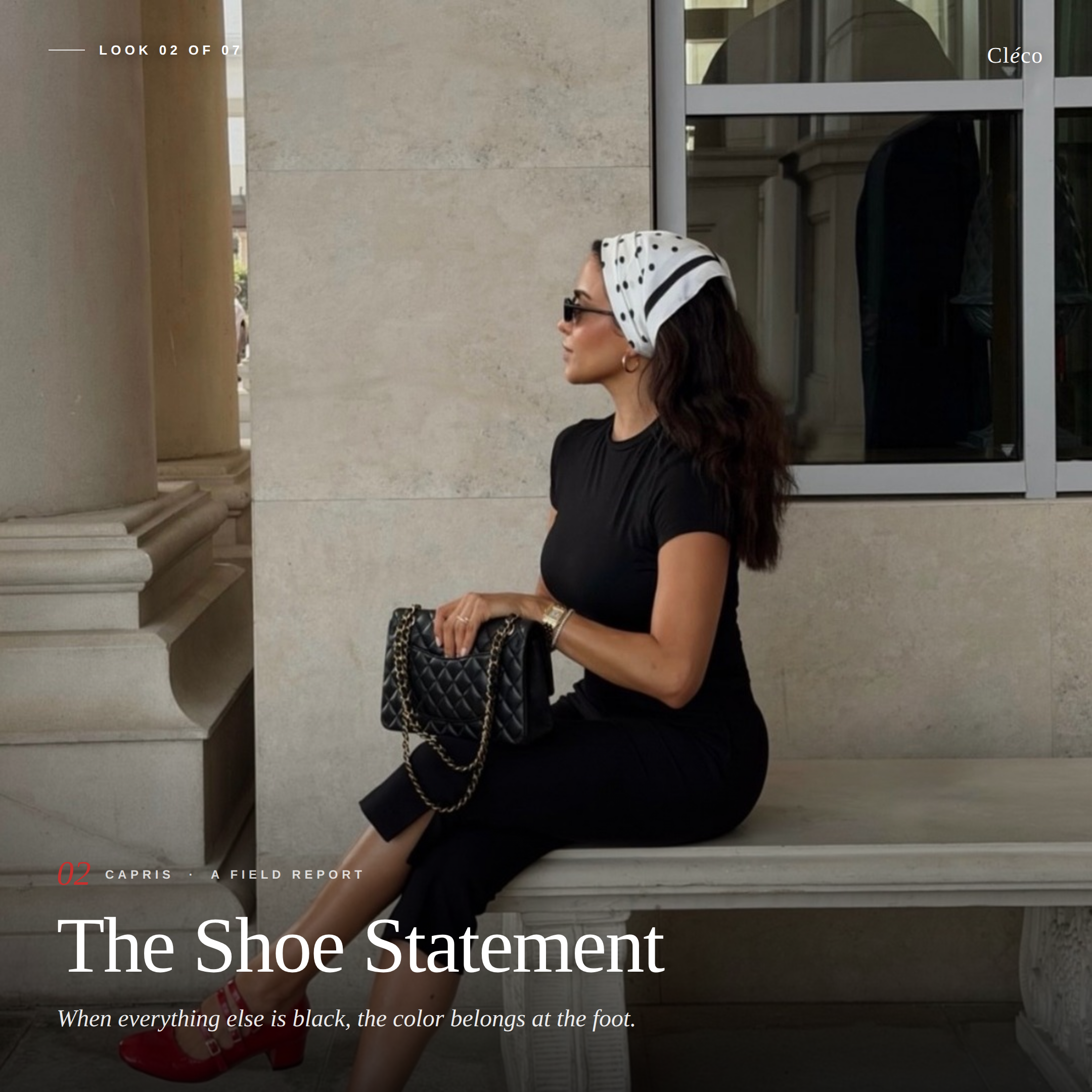
The shoe finishes the line. Where the early-2000s capri was paired with platforms, wedges, and chunky sandals — all of which compounded the proportion problem — the new capri is being worn with low-vamp ballet flats, kitten heels, slingbacks, Mary Janes, and elevated thong sandals. Stylists are explicit about why: a sleek pointed flat or refined heel lengthens the leg precisely where the capri's hem cuts it off. The shoe is doing the work the pant won't.
The waist sits higher. The 2003 capri sat below the navel. The 2026 capri sits at the natural waist. Speaking to WWD, Dacey Trotta — founder of the label Rumored — argued that what modernizes the silhouette is a higher rise, a clean waistband, and compressive fabric. The pant is now adding length at the top, not subtracting it at the bottom.
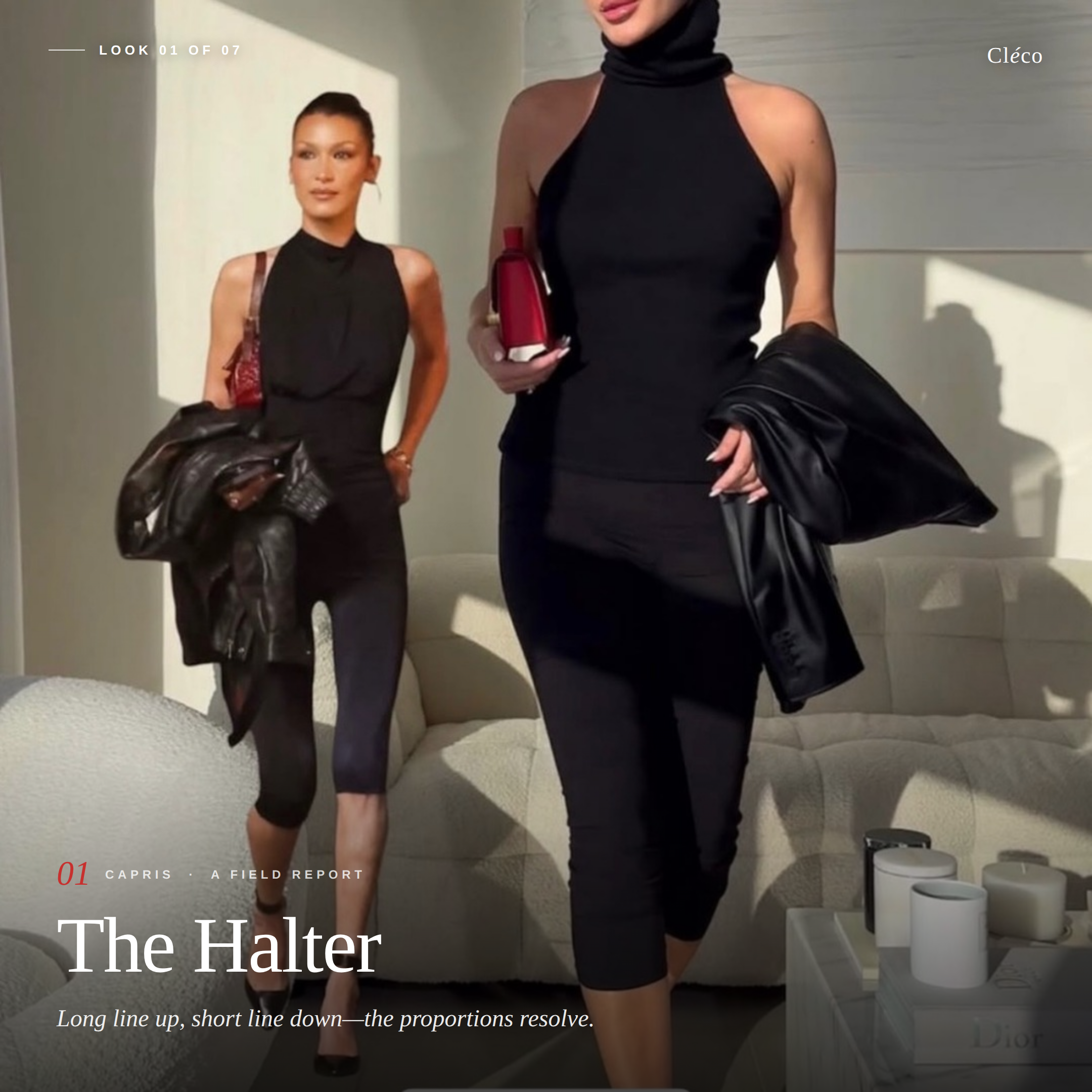
The top half is disciplined. Where the original era styled volume against volume, the new capri is being worn with halters, fitted tees, structured blazers, and oversized pieces deliberately belted at the waist. The principle: if you crop the bottom, you have to lengthen the top. The vertical line up the torso has to do the work the cropped hem won't.
The runway argument
The shift on the runway has been consistent across designers who do not normally agree with each other. Ralph Lauren's Spring 2026 capri looks were styled with restrained palettes and sharp tailoring. Proenza Schouler took a similar minimalist approach. Sandy Liang pushed the silhouette playful, working in floral and lace pedal pushers. Miu Miu has continued threading cropped pants through their most recent collections.
The retail follow has been quiet but firm. Cropped, fitted, jersey-knit and ponte-pant capris have moved from "novelty SKU" to a stocked staple at brands as different as Cos, Skims, and Reformation. The cycle from runway permission to street adoption used to take years. With the capri, it took months — accelerated through summer 2025 by Bella Hadid, Emily Ratajkowski, and Hailey Bieber wearing the silhouette publicly enough that the broader culture took permission.
Seven styling rules, distilled
Walk through what the well-dressed are actually doing this season and a styling logic emerges. The rules below are descriptive, not prescriptive — observations from where the look is actually working.
Lengthen above what you crop below. A halter, a turtleneck, a tucked tee. The vertical line up the torso has to extend what the hem shortens.
End the foot at the foot. No platforms, no clunk. The shoe should be where the foot is. A ballet flat, a kitten heel, a slim slingback. The 2003 mistake was making the shoe a separate event from the leg.
Use color once. A red Mary Jane. A brown blazer. A printed top. One of these per look, not all three. The 2000s styled color everywhere; the 2026 styling treats it as punctuation.
Belt the volume. If the top is oversized — a trench, an unbuttoned blazer — pull the eye back to the waist. An unbelted oversize blazer over a capri compounds the same proportion mistake the original era made.
Pattern above the belt. Print belongs up top. The capri's job is to stay disciplined and quiet. A printed capri is almost always working against itself.
Match the tailoring weight. A structured-shoulder top reads sharper against the capri than a soft-shoulder one. The pant rewards structure. It is unkind to slouch.
Keep accessories small. A compact bag, a thin earring, a refined sunglass. The capri is already a statement of proportion. The wardrobe doesn't need to argue with it.
Why this is more than a trend cycle
It is tempting to file the capri's return under "twenty-year flip" — fashion's habit of recycling silhouettes on a generational clock. The framing is true and incomplete. Silhouettes do return on schedule. But silhouettes only work when the styling logic around them is rebuilt to solve the problems the original era couldn't.
The capri is a clean case study. The pant on the rack at Cos this spring and the pant on the rack at Express in 2003 are technically nearly identical — same length, same fit, same intention. What is different is everything that surrounds it. The shoe is different. The rise is different. The top is different. The accessories are different. The cultural permission is different.
This is, ultimately, how fashion actually moves. Not as a recurrence of shapes, but as a recurrence of shapes with new rules attached. The shape returns when culture has built a vocabulary capable of holding it.
If you find yourself trying the capri this season and it isn't working, the silhouette is not the problem. Check the shoe. Check the rise. Check the color count.
The pant will tell you which rule you broke.
Sources: WWD, Heuritech, women.com, Khaite Spring/Summer 2026, Ralph Lauren Spring 2026, Sandy Liang Spring 2026.
